Showing posts with label Christ. Show all posts

Saturday, July 19, 2014

Goodreads review: Imitation of Christ

Imitation of ChristImitation of Christ by Thomas à Kempis

My rating: 5 of 5 stars


No accident that Imitation of Christ is, second to the Bible, the most beloved book in Christendom. Filled with sound doctrine and timeless exhortations to religious perfection, it offers no fashionable alternatives nor shortcuts nor culturally correct 'relevance'. It is a work for all seasons and all centuries. Its target audience is the serious Christian, no one else. It simply instructs the reader on the Truth and on how therefore to live. It is to be slowly absorbed, not just read.

This passage, written in the person of Christ, may be the most perfect portrayal of the Cross that I've ever found:
Of my own will did I offer up myself unto God the Father for thy sins. My hands were stretched forth on the cross, and my body laid bare, so that nothing remained in me that was not wholly turned into a sacrifice for the appeasing of the divine majesty. [4th Book, Ch.VIII,1a]

If Imitation of Christ has a flaw, it is that it was intended for monks and hermits. As such, many of its exhortations, such as
Choose therefore a secret place to thyself, love to live alone with thyself, desire the conversation of none; but rather pour out devout prayer unto God, that thou mayest keep thy soul contrite, and thy conscience pure. [3rd Book, Ch.LIII,1c]
can not be literally practiced by, say, a married person or a parish priest, whose vocation necessarily involves contact with people. This caveat, in my opinion, does not detract from the book's profound prophetic worth.


View all my goodreads reviews

Monday, August 26, 2013

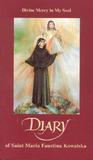
Goodreads review: Diary of Saint Maria Faustina Kowalska

Diary of Saint Maria Faustina Kowalska: Divine Mercy in My SoulDiary of Saint Maria Faustina Kowalska: Divine Mercy in My Soul by Faustina Kowalska

My rating: 5 of 5 stars


Sister Faustina writes her diary as a very frank and open disclosure of visions and locutions which she continually experienced over a period of several years. In it, she reveals her petty grievances and imperfections mixed in with an earnest and wholehearted drive for sanctity. She lived and wrote 100 years ago, having grown up in a typical Polish family, and entering religious life at about 20 years of age. Thanks to a couple of wise confessors, she was encouraged to not only follow the extraordinary visions given her but to write about them, the result being this very book.

Sister Faustina's relationship with her Savior was a spousal one. Jesus was not only her Lord and God but her divine husband. She saw herself as a bride of Christ, and her notes are marked by radical intimacy, devotion, docility and obedience. She is called by Christ to a special mission, that of spreading devotion to His greatest attribute, His mercy.

In some respects, her presentation of Divine Mercy is very much like the Evangelical notion of a simple faith conversion experience. Any soul, especially a hardened sinner, need only put his trust in the Mercy of the Savior, and he can be assured of a place in heaven; all sin is instantly forgiven, obliterated by the justifying sacrifice of Christ on the Cross. But Sister Faustina's experience of Divine Mercy is wholly Catholic in its understanding. Her revelations never consciously strayed from Catholic doctrine, and everything she experienced was subjected to the discernment of her superiors, confessors and spiritual directors.

This Divine Mercy is constantly contrasted with her own unworthiness and with the wrath of God which she and every sinner rightly deserves. It is, moreover, a very costly gift. Sister Faustina's short life was marked by an extraordinary amount of physical, emotional and spiritual suffering, which she came to see as a sharing in Christ's own salvific sufferings. As Christ's bride, it was her duty and high privilege to suffer like and with Him, and for the same purpose - to bring wayward souls to salvation. So much so that she begged Jesus to allow her to drain her cup of suffering to the last dreg. She was granted this request, and, after years of intense suffering, died of tuberculosis at the Christ-like age of 33.

Two quotes from the book:

"Some day, we will know the value of suffering, but then we will no longer be able to suffer." [963]

"If the angels were capable of envy, they would envy us for two things: one is the receiving of Holy Communion, and the other is suffering." [1804]

Let the reader - especially the serious Catholic - beware. This book could change your life.


View all my goodreads reviews

Monday, December 31, 2007

Milksop Christianity

I would like to commend those few Catholic parishes in which yesterday's 2nd reading was proclaimed in its long form (Col. 3:12-21) rather than in its short form (Col. 3:12-17). The short option omits the part about wives being subject to their husbands. Rather than appear (gasp!) old-fashioned, or (double gasp!) patriarchal, or risk (triple gasp!) offending someone, most parishes simply skip the risky portion. A few priests may feebly attempt a clever it-isn't-what-it-looks-like dismantling of the text. Most just ignore it, and hope nobody notices.

Trouble is, Christianity is, and has always been, a patriarchal religion, as is Judaism. Indeed, marriage itself is a patriarchal institution, and civilization, founded upon marriage, is founded upon patriarchal principles.

A few prophetic voices have begun to descry and decry the effeminate, wan softness of our degenerate culture, a culture that is embarrassed by patriarchal authority. I would say 'Amen' to these prophetic cries, and point to Jesus as a manly man who likewise expects counter-cultural strength in his followers.

It's high time for Christians to realize that the cultural rejection of patriarchy is ultimately a rejection of the family, of traditional moral values, and of Christianity itself. And it's high time to stop our milksop acquiescence towards this prevailing attitude, and unflinchingly proclaim the timeless truth.

Friday, December 28, 2007

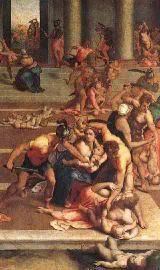
Slaughter of the Innocents

...Rachel weeping for her children...(Mt. 2:18, Jer. 31:15 [RSV])

Slaughter of the Holy Innocents In a sort of inverse of the progression from Good Friday to Easter, just three days after the joy of Christmas we commemorate the very first Christian martyrs, those infants who were slaughtered by Herod out of rage and fear towards the newborn Christ. Pro-life Christians have adopted this feast day of the Holy Innocents (Dec. 28) as a fitting commemoration of the slaughter of the innocents that continues in our abortion clinics today.

The modern Herods are those who wear a doctor's attire as they ply their vile trade, shedding the blood of innocent and helpless babies for monetary gain. These present-day Herods have a large army of soldiers to help and enable them. They have the arrogant judges who have decreed that this murder must be allowed and sanctioned by the state. They have the politicians who enact legislation to grant them public subsidies and punish those who would rescue the innocent. They have voters who continue to elect such, in tacit approval of the slaughter.

I will repeat the last sentence. Herod today has voters who enable his wicked slaughter by their choices in the ballot box.

Here's a helpful link.

Friday, December 21, 2007

Christmas

...may we come to share the divinity of Christ who humbled himself to share in our humanity.

Just think - the infinite, eternal God humbled himself to enter the finite space and time of this world, and become one of us! This awesome Christian doctrine of the Incarnation is, of course, central to our celebration of Christmas.

But there's more. Liturgically, Christmas is the first of several 'epiphany', or 'manifestation' celebrations. The appearance of the star, leading the Magi (us Gentiles) to the Messiah, is a second instance of this manifestation. Next, John the Baptist recognizes and proclaims the Christ when Jesus comes for baptism, a third instance of Christ revealing himself. Next, Jesus performs his first miracle, changing water into wine at the Cana wedding feast, thus beginning his public ministry. Christmas, Epiphany, the Baptism in the Jordan, and the wedding at Cana, are celebrated in close proximity because they are all celebrations of the same thing: of the appearance of the Messiah, the Son of God among us.

The Annunciation In a different manner, Christmas is also closely associated with another liturgical celebration, one that is less apparent, more hidden, but perhaps more profound. That liturgical celebration is March 25, the Feast of the Annunciation, when the angel Gabriel announces to Mary that she is to become the mother of the Christ, and Mary says 'Yes'. This is the real moment of Incarnation, when 'the Word became flesh, and dwelt among us'. It is at this moment that God becomes one of us and takes on human flesh within the womb of the Virgin. Nine months later, on December 25, Christ is born. He makes his appearance, and the truth that was hidden for nine months becomes manifest.

As noted in an earlier post, belief in the Incarnation has (or should have) some very practical ramifications for the believer. Each of us is also an incarnation of sorts, a union of a physical, animal body with an eternal, spiritual soul. And, like Christ, our personal incarnation began before we were born. The joyous event of birth is but the manifestation of an incarnation that had its hidden beginning nine months before.