Tuesday, March 18, 2008

Pro-life strike

Lent is a time for repentance, for conversion, for fresh insight and clarity. This can mean a whole new direction, or rediscovering and revitalizing a neglected or faded vision.

22-week-old aborted baby Over 15 years ago, the notion of a pro-life strike began to grow within me. The accepted approach of praying, protesting, writing letters, and employing gentle and patient persuasion is much too mild. Millions of innocent lives are being destroyed, millions of mothers irreparably mutilated, and pro-lifers are being polite about it.

Nor does the Scriptural argument to "render to Caesar..." and to "pay taxes to whom taxes are due" hold much water in this case. Remember that "we must obey God rather than men" (Acts 5:29) is also a Scriptural principle.

If you really need a literal interpretation, consider that Jesus added, "...and [render] to God the things that are God's" (Mt 22:21).  Does not our money still say "In God we trust"? How can we justify surrendering God's money for tax-funded abortions?

And is not our government supposed to be a government of the people? Then who is 'Caesar' in this case, if not we ourselves?

No, the timid approach is not only ineffective, it is unscriptural and ungodly as well.

The American Revolution was fought over unjust taxes. Loyalists argued that fealty to the king was the more righteous course. Do you agree? There is much more at stake this time. We know well that unless America repents, she must earn God's judgment. And judgment begins with the household of God (I Peter 4:19).
Let's strike, even if we strike out! So, this blog post is one last appeal to anyone out there, whether you are a pro-life leader or one of the rank and file. Let us take a big risk, let us put our lives and our livelihoods on the line for this cause that we profess. Let us engage the unrighteous juggernaut in language that it can understand - in economic terms. Specifically, in terms of tax dollars. Let us go on strike. At the very least, let us organize a tax resistance movement. Let us, perhaps, pull out of the mainstream altogether, maybe forge our own underground economy. The two-edged point is to push hard for legal protection for the innocent pre-born, and to withhold all material cooperation with the holocaust. Let us finally win this war, or ruin ourselves in the trying.

Please read my similar blog post of over a year ago entitled "Strike Three!". There appears to be at least one like-minded individual, in Canada (see this article), but we seem to be few in number, or very well hidden. This should not be so. So, if this idea finds a place in your conscience, let me hear from you. If you know of others who may be interested, or who are already pursuing such a course, point them out to me, or me to them. Being on strike alone is also quite ineffective, and Jerry grows old and weary.


(Note added 3/31/8):

It has been suggested that some folks might be reticent about publicly debating this issue. Maybe an underground movement is already afoot, or something. I do believe some kind of coordination is needed. At any rate, if you prefer to leave a private comment to be read only by Jerry, click here or on the 'Private note' link on the left side bar.

I may add more posts providing details on principles and specific strategies, as I see them. I welcome any comments or suggestions.

Wednesday, March 12, 2008

What is truth?

To love only to seek - on condition of never finding - to want only disquietude, that is to hate truth.
  - Jacques Maritain

αληθεια Before Pilate, Jesus said

". . . For this I was born, and for this I have come into the world, to bear witness to the truth. Every one who is of the truth hears my voice."
Pilate said to him, "What is truth?"
  - John 18:37b,38 [RSV]
Pilate's question seems unmistakably cynical, a clear implication that, to Pilate, there is no such thing as truth, or that it cannot be attained.

It strikes me that this same disparity of viewpoints toward truth exists today, and explains much of the widening polarity in our culture. Both in politics and in the Church, the liberal or progressive thinker doesn't believe that the truth can be known with any degree of certitude. Thus, abortion may be lamentable, but not an absolute evil. Our definition for marriage or for family can be fluid, and can change as our understanding enters into broader horizons. Religions are all basically the same; none should be disparaged, and none should be especially esteemed above others. The conservative insistence upon unchanging values appears rigid and stubborn, probably rooted in fear, bigotry, and ignorance. The conservative's claim to know the truth seems arrogant and elitist. After all, no one can really know anything with any absolute certainty, so there can be no such thing as unchanging truth or immutable values.

At the other end, conservative thinkers often try to reason with their liberal friends, using the rigorous rules of logic, dialectic, deduction, induction, Scriptural exegesis, etc. But the arguments fall onto deaf ears, or onto ears that don't recognize such language. It's frustrating, like trying to nail Jello to the wall.

And so, we have an impasse, an ever-widening breach. Now, I don't know how one would go about bridging this gap, or if that is even possible, or desirable. But it occurs to me that the exchange between Jesus and Pilate may mirror the confrontation in our own culture, and so may shed some light upon what's really at stake here.

In many passages besides the one already cited, Jesus speaks of truth and seems to put great emphasis upon it. He says, for example, that ". . . you will know the truth, and the truth will make you free."  (John 8:32)  In the early Church, the apostles likewise take up this mantle and speak quite forcefully for truth and against erroneous doctrines.

In perhaps the most telling passage, Jesus identifies Himself as Truth personified when He says, ". . . I am the way, the truth, and the life. . ."  (John 14:6)  Taking this utterance at face value, one would have to conclude that to seek and embrace the truth is to seek and embrace Jesus; to deny or avoid the truth is to deny or avoid Jesus. (Of course, someone who denies truth would probably not take this or any other Scripture at face value anyway [sigh]).

Well, maybe it all just comes down to whom you believe is the more laudable role model: the open-minded Pilate, or the narrow and rigid Jesus.

Thursday, March 6, 2008

Sermon on the Mount

Senator Barack Obama recently expressed confusion over what the Bible teaches on homosexual unions, and suggested the Sermon on the Mount (Mt.5:1-7:29) for clarification. Senator Barack Obama This struck me as sage advice, so as a Lenten exercise, I have prayerfully reviewed that passage, with an eye especially for anything regarding homosexuality.

The Sermon on the Mount is, of course, a deep and multi-layered discourse, saying much about the path to God and the life of faith, containing way too many profundities to even mention in one blog post. Here are just a few little thoughts:

Early in His discourse (Mt.5:17-20), Jesus declares that He has come, not to abolish or diminish Old Testament teachings, but to fulfill them, to enlarge upon them. Now, it is well known that homosexual activity is categorically condemned in the Mosaic Law of the Old Testament. In Leviticus 20:10-16, for example, homosexuality is listed along with adultery, incest, and bestiality as the capital sexual sins, i.e., deserving the death penalty. So, as to the special focus here, Jesus would seem to be confirming and even strengthening the Mosaic prohibition against homosexual acts. This becomes even clearer in the remainder of chapter 5 (Mt.5:21-48), where Jesus gives six instances of His fulfilling or strengthening of O.T. precepts. In each example - murder, adultery, divorce, oaths, justice, and love - the commands of Jesus go beyond what the O.T. required; His commands are stricter and more comprehensive than the Mosaic statutes. Note that adultery, one of the capital sexual sins, is explicitly included. Not only is adultery condemned by Jesus, but even the lustful thoughts leading up to the actual adulterous act. One would have to conclude that the same principle applies to the other capital sexual sins as well: that we must be vigilant against the very thoughts and intentions leading up to the actual sins of incest, bestiality, and homosexuality.

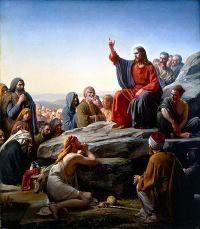
Sermon on the Mount As noted in a recent post, many have interpreted Mt.7:1 ("Judge not, lest ye be judged") as somehow providing license for all kinds of moral mischief. But the context (Mt.7:1-5) clearly talks about judging rightly, with clear vision. It condemns the condemning of certain behavior in others while excusing the same behavior in ourselves. It may also prohibit judging the inner secrets of another's heart which we cannot know. But in context it cannot reasonably mean that we must approve or condone sinful behavior, either in ourselves or in others. The apostles, the prophets, and Jesus Himself constantly exposed and judged sinful behavior.

The principle is profound but simple: love the sinner, hate the sin, both in ourselves and in others. To excuse sin is to belittle God's law and His holiness. To truly love the sinner (including myself), I must hate the sin which encumbers the sinner and keeps him from God. To excuse sin is to ignore the sinner's moral danger, and so to despise the sinner himself.

This principle applies to the special focus. Currently, many who profess the Christian faith have singled out homosexual behavior as something to be lauded or affirmed, rather than repented of as sin. This turns out, ironically, to be the ultimate homophobia. By their unwillingness to call this particular sin a sin, such Christians place a huge stumbling block in the path of their brothers who are so tempted. They single out homosexuals from other sinners, excusing them from the need for repentance, thus depriving them of the saving grace of repentance and forgiveness, and thus consigning them to eternal perdition. This is serious hatred! In contrast, Jesus loves the homosexual, and so calls him to repent. As with all sin, this is the only path to salvation and sanctity.

In Mt.7:13,14, Jesus warns us to avoid the easy way leading to destruction, then warns of false prophets (Mt.7:15-20), which also seems germane to the special focus. In the closing paragraph (Mt.7:24-27), Jesus gives another solemn warning: heeding His teachings leads to life and strength, ignoring them leads to collapse.

For once, the senator from Illinois got it right: the Sermon on the Mount has much to say on this and on many, many other issues. It is highly recommended reading.

Friday, February 22, 2008

Metanoia

In contemplating the transfiguration of Jesus, we might well ask what it means for us. Dare we ask for or expect a similar experience? May we be transfigured like Jesus?

Well, this side of resurrected life, the obvious answer is - No.  But if not transfigured, we might be transformed. In fact, by all scriptural accounts, those who come to faith in Jesus must be transformed, or converted. Metamorphosis The Greek word is μετανοια, or metanoia, etymologically related to μεταμορφοω, or metamorphoo. Metamorphosis is, of course, the radical transformation that occurs when a caterpillar forms a chrysalis and then emerges later as a butterfly. The change is striking, to say the least.

In Romans 12:2, Paul commands us "Do not be conformed to this world, but be transformed...", and then in 2 Cor.5:17 he says "if any one is in Christ, he is a new creation; the old has passed away, behold, the new has come." This obviously means a radical and total change, not just a little reforming job.

The question is: is this transformation something we do, or a miracle of grace? It is, of course, the latter, since none of us has the power to change his own nature. Yet, it is presented as a command as well. If we claim to belong to Jesus, we must avail ourselves of that grace, do what we can to submit to the changes the Holy Spirit wants to accomplish in us. That's a big part of what Lent is to be about.

OK - anybody out there have some hints to help me get started on my cocoon?

Friday, February 15, 2008

Transfiguration

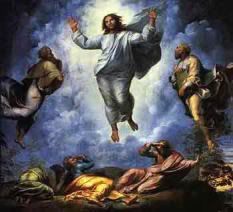
Transfiguration We are accustomed to hear the account of Christ's transfiguration without the surrounding context. The full story can be found in Mt.16:21-17:21, Mk.8:31-9:29, and Lk.9:22-43, with all three synoptic Gospels giving the same contextual details:

Jesus tells his disciples that he must go to Jerusalem to die and then to rise again. Then he tells them that every disciple of his must also deny himself, take up his cross and lose his life. Then he says that some of them would not die until the Kingdom of God had come. Then he takes Peter, James, and John with him up Mount Tabor, and appears in great glory with Moses and Elijah. The three disciples are dazzled, Peter wants to erect booths (tents? tabernacles?) for the three glorious figures, a cloud overshadows them, and they hear God say "This is my beloved Son; listen to him.". After that, Jesus alone is to be seen, back to his normal state. On the way back down, Jesus orders the three disciples not to talk about this event until he has died and risen. Once down from the mountain, Jesus casts out a demon which the other disciples had tried to expel but couldn't.

It seems significant that the surrounding details are consistent in all three accounts. It would seem that the transfiguration, that foretaste of resurrected and heavenly glory, is inextricably tied to self-denial and to the cross. This is true not only for Jesus, but for us as well. The flip side is that, in the midst of our crosses and of our desert times, we can take heart and derive strength from the promise of victorious resurrection life. The cross and the resurrection are two sides of a single redemption coin. Our battle against sin and against Satan will be futile outside of this reality.

Friday, February 8, 2008

Knowing good and evil

When Adam and Eve ate the fruit of the tree of the knowledge of good and evil, just what did that mean? At face value, it seems to simply say that Man became a moral being, capable of knowing right from wrong, and capable of freely choosing either. We cannot be amoral like the animals; we can only be moral or immoral.

No less than John Paul II has suggested a deeper meaning as well. Namely, that the original sin of Man involved deciding what is good and what is evil, in direct rebellion of God's authority. Note the serpent's words: "You will be like God, knowing good and evil". Rather than agree with God's judgment of sin, we want to make up our own rules.

Sound familiar? Of course it does - we hear this all the time, even perhaps from our pulpits. "Each person must find his or her own truth" or: "Only you can decide what is right and wrong for you" or: "Sin is whatever you feel it to be" If this relativism is questioned, the inevitable out-of-context comeback is "Judge not, lest ye be judged."

Whether you call it a serpent's hiss, or "Values clarification", it's still a deception. Repentance starts with agreeing with God, and recognizing that what He says is good is good, and what He says is evil is evil.

Wednesday, February 6, 2008

Repentance, a sweet deal

Here it is, Ash Wednesday, and the Church is calling me to repent of my sins again. What a bummer! I mean, I thought I'd done that repentance thing already - what's the deal, anyway? . . . Well - - OK - I've been sinning again, that's the deal. Truth is, I never really stopped. Maybe slowed down a couple times, that's all.

Speaking of deals, repentance is a pretty sweet offer, when you think of it. Sin, even the major ones, need not keep us from God nor from eternal life. Just agree with God that sin is evil, ask forgiveness, and purpose to do better, with God's grace. That's repentance.

Jesus died so we could have such a deal. That is to say, the cross is the remedy for sin. Taking on our sins was Jesus' part; belief and repentance is our part of the deal. But there is no remedy for making excuses, for rationalizing and justifying our sinful ways. Just repent - agree with God that sin is wrong. To refuse to do so is to refuse the sweet deal, and to remain trapped in the deadly pit our sins have dug us into.