Showing posts with label Transfiguration. Show all posts

Friday, February 22, 2008

Metanoia

In contemplating the transfiguration of Jesus, we might well ask what it means for us. Dare we ask for or expect a similar experience? May we be transfigured like Jesus?

Well, this side of resurrected life, the obvious answer is - No.  But if not transfigured, we might be transformed. In fact, by all scriptural accounts, those who come to faith in Jesus must be transformed, or converted. Metamorphosis The Greek word is μετανοια, or metanoia, etymologically related to μεταμορφοω, or metamorphoo. Metamorphosis is, of course, the radical transformation that occurs when a caterpillar forms a chrysalis and then emerges later as a butterfly. The change is striking, to say the least.

In Romans 12:2, Paul commands us "Do not be conformed to this world, but be transformed...", and then in 2 Cor.5:17 he says "if any one is in Christ, he is a new creation; the old has passed away, behold, the new has come." This obviously means a radical and total change, not just a little reforming job.

The question is: is this transformation something we do, or a miracle of grace? It is, of course, the latter, since none of us has the power to change his own nature. Yet, it is presented as a command as well. If we claim to belong to Jesus, we must avail ourselves of that grace, do what we can to submit to the changes the Holy Spirit wants to accomplish in us. That's a big part of what Lent is to be about.

OK - anybody out there have some hints to help me get started on my cocoon?

Friday, February 15, 2008

Transfiguration

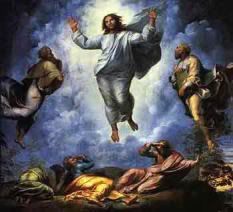
Transfiguration We are accustomed to hear the account of Christ's transfiguration without the surrounding context. The full story can be found in Mt.16:21-17:21, Mk.8:31-9:29, and Lk.9:22-43, with all three synoptic Gospels giving the same contextual details:

Jesus tells his disciples that he must go to Jerusalem to die and then to rise again. Then he tells them that every disciple of his must also deny himself, take up his cross and lose his life. Then he says that some of them would not die until the Kingdom of God had come. Then he takes Peter, James, and John with him up Mount Tabor, and appears in great glory with Moses and Elijah. The three disciples are dazzled, Peter wants to erect booths (tents? tabernacles?) for the three glorious figures, a cloud overshadows them, and they hear God say "This is my beloved Son; listen to him.". After that, Jesus alone is to be seen, back to his normal state. On the way back down, Jesus orders the three disciples not to talk about this event until he has died and risen. Once down from the mountain, Jesus casts out a demon which the other disciples had tried to expel but couldn't.

It seems significant that the surrounding details are consistent in all three accounts. It would seem that the transfiguration, that foretaste of resurrected and heavenly glory, is inextricably tied to self-denial and to the cross. This is true not only for Jesus, but for us as well. The flip side is that, in the midst of our crosses and of our desert times, we can take heart and derive strength from the promise of victorious resurrection life. The cross and the resurrection are two sides of a single redemption coin. Our battle against sin and against Satan will be futile outside of this reality.