Showing posts with label Sanger. Show all posts

Tuesday, March 13, 2007

Thanatos

An early twentieth century movement seriously proposed the practice of selective breeding of the human species, usually known as eugenics. Margaret Sanger, a vocal eugenist, openly lamented the unrestricted propagation of "inferior types". She wrote about producing a "race of thoroughbreds", and eliminating "human weeds". (See this link for starters.) Founder of the American Birth Control League, today's Planned Parenthood, she mainly targeted her birth control measures to the poor, immigrants, and other minority groups. These remain the primary target clientele for Planned Parenthood today.

A similar eugenics philosophy lay behind Hitler's pogroms against Jews and other "inferior" peoples. It would seem that eugenics in practice must always become genocide. Well, the Allied forces defeated Hitler militarily, but the poisonous thinking of racism, eugenics, and genocide remains, still espoused by many, whether openly or covertly.

Moreover, beginning in the 1960's or so, another toxic idea related to human propagation began to be fed to us: that our very presence on this planet is a problem; that we by our nature are destroying the earth that we depend upon; we're using up finite resources and producing waste at an ever accelerated clip, the problem grows more acute every year, and the only apparent solution is to reduce our numbers.

Myth (mith), n.: A widely held belief based upon an imaginary or legendary story.
This story, usually told by well-fed academics of Europe and America, seems always to portend an imminent, deadly threshold. I am not discounting or minimizing the real crises and human need in many areas. Yet threshold after threshold is passed, and the anticipated doom doesn't materialize. Indeed, global per capita real income and standard of living appear to be holding steady or even modestly growing. Are there limits to human population growth? I suppose all finite things have limits. Are we near our own limit? I know of no reliable evidence that would suggest that we are, nor have i seen proof linking any particular crisis to a root cause of "too many people". Yet the myth, and the conviction of impending doom, continue to afflict many. (Ah, but there may well be an impending doom to fear - that of the righteous judgment of God upon our ungodly beliefs and practices!)

Now, here's where it gets interesting: Put the two toxic ideas together, and what you get is something very much like today's Planned Parenthood agenda, or the United Nations Population Control programs. Namely, you get the racist and genocidal campaign to 'help' the folks in poorer parts of the world (which just happen to be Hispanic, African, or Asian) to discover the sexual revolution and to have fewer children. You get foreign assistance offered only upon the adoption of liberal abortion laws, forced or coerced sterilization, etc. This was Margaret Sanger's eugenic goal from the get-go: target the 'inferior' peoples, doing whatever is necessary to ensure that they have fewer babies.

Herein lies the poetic irony (and divine judgment?): Demographic trends suggest that the people who have drunk most deeply of the toxic myth are precisely those from whose ranks the myth arose, but who were not targetted for extinction by Sanger and Hitler, nor by the myth makers, nor by current Planned Parenthood and United Nations population controllers. Germany and Japan, for example, are experiencing a severe drop in birth rates, far below replacement levels. France, at two births per woman, scarcely replacement level, has one of the highest birth rates in Europe. Worldwide, all birth rates seem to be slowing, but there is a definite demographic shift away from the formerly dominant and ascendant European stock, to folks from Africa, the Middle East, and Central and South America.

So, now the generalized fear of population growth takes on a more racist tone. Many in the U.S. feel threatened by the growing influx of people from Latin America. Europeans grow more wary of the rising tide of people, largely Muslim, from the Middle East. White Russia may soon become predominately Muslim and Chinese. Much is written, and feelings run high, regarding the perceived shift in demographic power.

I can't help thinking that there must be a connection here... That the eugenics/genocide ideology of Hitler, Sanger, et. al., rooted in racial fear, has now morphed into a sort of Thanatos syndrome, a culture-wide death wish on the part of the very people who were to become Sanger's "race of thoroughbreds", a paralysis of our collective will to propagate and thrive. Ironic that the debased thinking of Sanger and Hitler may actually have helped to fuel the very population changes they most feared!

What about a challenge to the premise: Do we, in fact, have to live in the consumeristic mentality that leads to such anti-life despair? Must we adopt the self-loathing mantra of the population control agenda? Or might we do better to try to rediscover a sustainable way of living, in which human beings are rightly seen, not as a liability, but as a vital resource? I hope to expand upon this hopeful thought.

Friday, February 23, 2007

Heresy

The words 'heresy' and 'heretic' may conjure up a sinister image for many, harking back to medieval times when there was much ado about such things. People willing to inflict injury, torture, and death, other folks willing to endure the same, all for the sake of some theological details. We tend to look disparagingly, or at least condescendingly, upon the primitive narrow-mindedness that would not esteem diversity of thought as we do today. Enlightened and educated, we now regard differences of opinion on such matters as a healthy thing, certainly not a cause for extreme reactions.

With that in mind, i recently looked into the etymology of the word 'heresy', and found that it was originally a quite innocuous term, even mundane. It comes directly from the Greek word αιρεσις (airesis or hairesis), which just means 'choice' or to 'choose' or 'select'. It's what the Greeks did at their market, and what you do at the mall or supermarket or video store. You pick and choose. You don't like that brand of peanut butter; you prefer this brand. That movie looks boring, but here's one that might be interesting. Certainly nothing evil or threatening in that. Choice is a good thing.

Well, i suppose it might be allowed that in some areas, a completely open-ended choosing might become problematic. We generally recognize, for instance, that in the military there needs to be a chain of command; it wouldn't work to have each individual soldier freely choosing what action to take. Likewise, in business, individual employees must sacrifice some autonomy and work to advance the collective success of the company, else the business will likely fail. Generally speaking, any human enterprise involving teamwork will necessarily also involve some curtailing of individual choice. Unity in religious faith is a special example of this. The bond of cohesiveness between believers assumes substantial agreement as to what beliefs they hold in common, else there is no bond.

But unity of faith goes beyond the teamwork priciple. The very pursuit of eternal truth presupposes that the truth is, in fact, attainable, and that other beliefs are therefore false and misleading. If truth exists at all, it must exist universally, and it must be singular. Pluralistic truth is an oxymoron. To speak of my truth is to speak of something that cannot be applied to others; i may as well speak of nothing at all. By contrast, the truth is worth speaking about, perhaps even arguing over.

The notion of pluralistic or relative truth carries with it the idea of the sovereignty of each individual self to decide what is and isn't true. So, besides being oxymoronic and intellectually untenable, this approach is essentially self-centered and arrogant, in that it vaunts the individual person's opinions above other considerations. Such intellectual myopia and self-centeredness would not seem to indicate a healthy faith. The more humble and honest approach would be to forget about pursuing my truth, and simply receive the truth as revealed and taught. Two examples:

The typical Evangelical proclaims the Bible to be the authoritative teacher of religious truth. But if that believer begins to 'pick and choose' which Scripture texts he will swear by, while ignoring, discounting, or explaining away the passages he doesn't like, that believer has ceased to be a true disciple and student of the Word, and has assumed the role of its critic and master instead.

In the same way, by claiming to be a Catholic, the Catholic believer implicitly accepts the Church as the authoritative teacher on matters of faith and morals. But if he freely selects which doctrines he will or will not hold, he is no longer a real Catholic. That is, his privately maintained beliefs cannot credibly be called 'catholic' or 'universal'.

So, to exercise airesis, to pick and choose what to believe, is incompatible with genuine faith. This is what the word heresy means.

And when you really think about it, these issues may be pretty important after all. Ideas do have consequences. What you believe will inevitably impact how you live your life, and will ultimately make our world either better or worse, depending upon whether your core values were good to start with. Those dusty theological details end up having enormous consequences.

Consider this: The Holocaust didn't just happen spontaneously. Early last century, a certain Margaret Sanger (founder of Planned Parenthood), and others, began to develop ideas about a master human race, the elimination of 'human weeds' (inferior races), and the deliberate undermining of Church authority to bring this about. Many leaders in the Third Reich acknowledged the writings of Sanger as the philosophical platform upon which they built their programs. If a strong resistance to heresy had been in place at that time, these racist and genocidal ideas would likely have remained the private thoughts of a few miserable souls, and would never have been admitted into matters of German policy.

This brings us back to the original questions. Is a concern over truth vs. heresy a dangerous attitude? Or merely rigid and antiquated? Or is heresy itself more dangerous and potentially fatal? Might those medieval folks actually have something to teach us today? Is 'agreeing to disagree' an enlightened attitude? Or a deadly one? Or, perhaps, merely a lazy and apathetic one?

Thursday, February 1, 2007

Persons

A person's a person, no matter how small
  - Horton
As in the previous post where i briefly discussed the definition of marriage, i turn now to the definition of persons. Not just the nominal definition where we decide to use the utterance "person" to mean a certain thing, but beyond that to a real or explanatory definition, to discovering what is the essence of the underlying reality.

In his book Healing the Culture, Robert J. Spitzer, S.J., Ph.D. moves through the 4 levels of definition, from the nominal, subjective definition to the objective explanation: what the subject is, what it does, and what is its final end or purpose. So, what is a person? What distinctive characteristics does a person possess? I cannot do justice to Dr. Spitzer's thorough analysis in one little blog post (i really recommend reading the book), but a brief summary would involve recognizing the inherent capacity for the transcendental: that persons alone have the drive and the ability to appreciate things like eternity, truth, love, goodness, beauty, etc. The religious perspective would call this the spiritual dimension of our nature.

Well, what of someone who doesn't appear to possess this dimensionality? Should such a one no longer be considered a person? Is a severely mentally handicapped individual not a person? What about someone in a persistent coma? For that matter, what of someone who is drunk? Or asleep? Turns out that the discovery of inherent powers also involves the recognition that these powers may not always be manifest, due to external or internal conditions, but that the underlying potential must still be acknowledged. Photobucket - Video and Image Hosting Else we would end up with the silly notion that someone's inherent personhood could be turned off and on like a faucet, or was dependent upon accidental conditions.

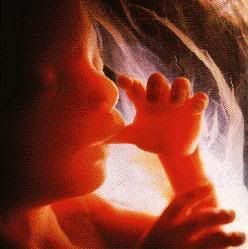
OK, so when does a person become a person? Glad you asked. This may be one of the least ambiguous questions, since we have the biological evidence to support what our theology has taught us all along: that the new person begins to exist at the moment of conception, when all of the potential powers first come into existence. Yep, that little muffin in the oven is not just a blob of tissue, but a real person.

The quite simple yet undeniably reasonable conclusion to all this is this: that every being of human origin should be considered a person.

Even were we to entertain questions about this conclusion, we would do well to err on the side of caution, and assume personhood rather than deny it. History demonstrates the bleak alternative: Hitler doubted the inherent potential of non-Aryans. The Dred Scott decision questioned the full personhood of black slaves. Margaret Sanger, founder of Planned Parenthood, repeatedly expressed doubt over the worthiness of the "inferior races". And on and on.

The ramifications are clear. Since the pre-born baby and the comatose patient are persons, let's see them as Whos and not merely whats.