Showing posts with label nominal. Show all posts

Thursday, February 1, 2007

Persons

A person's a person, no matter how small
  - Horton
As in the previous post where i briefly discussed the definition of marriage, i turn now to the definition of persons. Not just the nominal definition where we decide to use the utterance "person" to mean a certain thing, but beyond that to a real or explanatory definition, to discovering what is the essence of the underlying reality.

In his book Healing the Culture, Robert J. Spitzer, S.J., Ph.D. moves through the 4 levels of definition, from the nominal, subjective definition to the objective explanation: what the subject is, what it does, and what is its final end or purpose. So, what is a person? What distinctive characteristics does a person possess? I cannot do justice to Dr. Spitzer's thorough analysis in one little blog post (i really recommend reading the book), but a brief summary would involve recognizing the inherent capacity for the transcendental: that persons alone have the drive and the ability to appreciate things like eternity, truth, love, goodness, beauty, etc. The religious perspective would call this the spiritual dimension of our nature.

Well, what of someone who doesn't appear to possess this dimensionality? Should such a one no longer be considered a person? Is a severely mentally handicapped individual not a person? What about someone in a persistent coma? For that matter, what of someone who is drunk? Or asleep? Turns out that the discovery of inherent powers also involves the recognition that these powers may not always be manifest, due to external or internal conditions, but that the underlying potential must still be acknowledged. Photobucket - Video and Image Hosting Else we would end up with the silly notion that someone's inherent personhood could be turned off and on like a faucet, or was dependent upon accidental conditions.
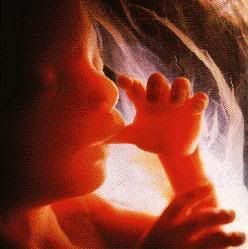
OK, so when does a person become a person? Glad you asked. This may be one of the least ambiguous questions, since we have the biological evidence to support what our theology has taught us all along: that the new person begins to exist at the moment of conception, when all of the potential powers first come into existence. Yep, that little muffin in the oven is not just a blob of tissue, but a real person.

The quite simple yet undeniably reasonable conclusion to all this is this: that every being of human origin should be considered a person.

Even were we to entertain questions about this conclusion, we would do well to err on the side of caution, and assume personhood rather than deny it. History demonstrates the bleak alternative: Hitler doubted the inherent potential of non-Aryans. The Dred Scott decision questioned the full personhood of black slaves. Margaret Sanger, founder of Planned Parenthood, repeatedly expressed doubt over the worthiness of the "inferior races". And on and on.

The ramifications are clear. Since the pre-born baby and the comatose patient are persons, let's see them as Whos and not merely whats.

Saturday, January 27, 2007

Nominal definitions

A rose by any other name would smell as sweet.
  - from Romeo and Juliet
My last two posts, on Tolerance and Unconditional love may have a common theme, i.e., my complaint about the corruption of words and their meanings to suit a particular viewpoint.

Some folks may even seek to change the very definition of a word to fit their ideology. The underlying premise seems to be that words have only a subjective meaning, and, in one sense, this is correct. For example, the decision to call the seed of an oak tree an "acorn" is merely nominal and subjective. We could just as well call it a "plebsit", or use the utterance "acorn" to refer, say, to the seed of a pine tree instead. This is true as far as it goes. The illogic comes if we expect the acorn itself to actually become like a pine cone because we've changed the word or its nominal definition.

I am indebted to Robert J. Spitzer, S.J., Ph.D. and his book Healing the Culture for his methodical examination of the 4 classic levels of definition. (Thanks also to Erika P. for giving me the book.) The first level of definition is the nominal level, where we humans decide what to call something, what utterance to attach to it. The next 3 levels are what we discover about the thing - what it is, what it does, and its ultimate end or purpose. These 3 levels are objective, and inherent to the thing at hand. Thus, the acorn continues to be what it is, and continues to carry the same potential regardless of what utterance is attached to it. You would do well to read Spitzer's own more thorough discussion at this link.

Spitzer is concerned in his work primarily with moving on to a philosophy of happiness, freedom, and life issues. In particular, the objective definition of what constitutes a person is important, and i hope to devote more blog space to that theme some time. For now, i would like to suggest another current example of misappropriating a word's definition...

Marriage

For centuries, marriage has been defined as a union between a man and a woman, usually publicly acknowledged, and usually including sexual relations and the conception and raising of children. Certainly in Western Civilization this has been the case. Not only has the word been so defined, but the underlying substance has long been recognized as central to the cohesion of society. The arrangement of marriage facilitates the domestication of men, the protection of women, and the inclusion of men in the rearing of children. It thus forms the very foundation and cornerstone of civilization as we know it. These principles are inherently part of what makes marriage what it is. Even were we to change the nominal definition of marriage, the underlying reality would remain.

Why do i bring this up? Because i have recently been involved in a few conversations in which another party argues that marriage is something that government or society can define or redefine, or that it is a human right that ought to be extended to same-sex couples. The danger in this line of thinking, as i see it, is not that same-sex marriages would somehow denigrate or tarnish heterosexual marriages. Marriage simply is what it is regardless of any subjective legislative or judicial decree that may be handed down. The danger is, rather, that if we as a society begin to neglect the foundational value of marriage in its objective meaning, we may very well be dismantling our own civilization. This is much more than just a subjective wrangling over words.

The morality of homosexual relations is a topic in its own right, which i will not attempt to address right now. The point of this particular post is just to say that words mean things, that the term "same-sex marriage" is an oxymoron, and that it behooves us not to meddle with our civilization's very roots.

You may also want to check out this blog for some excellent discussion of this and related topics.